How Did America’s Top General Turn Against Former Vice President Aaron Burr?
The U.S. Army’s senior officer, General James Wilkinson, sent President Thomas Jefferson a decoded letter that offered him second place in former Vice President Aaron Burr’s expedition. Wilkinson had removed the opening line, which acknowledged earlier correspondence.
How did Wilkinson turn against Burr while keeping his own dealings out of the version he sent Jefferson?
Natchitoches, early October 1806 — According to General James Wilkinson’s sworn account, a courier named Samuel Swartwout delivered an encrypted letter with news from former Vice President Aaron Burr’s circle. The enterprise, the letter said, had already begun. It claimed that money had been obtained and followers had their final orders, and it proposed a November 1 rendezvous on the Ohio River.
The letter had a particularly interesting offer for Wilkinson: he would rank second only to Burr and have authority over the rank and promotion of officers. Who wrote the version Wilkinson received is uncertain. The likely author was Burr associate Jonathan Dayton, a former speaker of the House.
Burr looks west
Two years earlier, Burr’s prospects for high office had collapsed in a matter of months. In February 1804, Republican members of Congress nominated President Thomas Jefferson for another term and chose George Clinton to replace Burr on the ticket. That April, Burr lost the New York governor’s race to Morgan Lewis. In July, he shot Alexander Hamilton in a duel at Weehawken, New Jersey; Hamilton died the next day, and Burr was indicted in New York and New Jersey but never stood trial for the killing.
Burr was still vice president that August when Anthony Merry, Britain’s minister to the United States, reported an overture to London. According to Merry, Burr offered to help separate the American West from the Union in exchange for British money and warships. That was a reported proposal, not a British commitment.
After leaving office in March 1805, Burr traveled west, recruiting supporters and arranging supplies for an expedition down the Mississippi. What he ultimately intended remains disputed. Jefferson later told Congress that the enterprise might aim to separate the West from the Union, attack Spanish-ruled Mexico, or do both. There was also talk of a settlement on the Washita, now known as the Ouachita River, which Jefferson regarded as a cover.
Whatever the objective, Burr counted on Wilkinson’s military support. Wilkinson was the Army’s senior officer, had command responsibilities on the western frontier, and had been appointed governor of the Louisiana Territory by Jefferson. He was also a paid Spanish informant known as Agent 13.
A warning first, a transcript later
Wilkinson turned against Burr by warning Jefferson about the expedition and later supplying an altered reading of the cipher letter. His warning was dated October 21, 1806, but Jefferson didn’t receive it until November 25. The president had already ordered precautions based on other reports. Two days after the warning arrived, he issued a proclamation calling on civil and military officials to stop an unlawful expedition against Spanish territory, without naming Burr.
The decoded letter was not what prompted that proclamation. Jefferson received Wilkinson’s altered transcript on January 18, 1807, nearly two months later. Wilkinson admitted removing the opening acknowledgment of an earlier letter postmarked May 13. He left in the offer to make him second-in-command, but took out the line showing that the two sides had already been in touch.
That distinction mattered: an offer could be made without Wilkinson’s consent, while the missing line showed prior correspondence. Even the full sentence, though, didn’t prove that Wilkinson had agreed to the scheme. The deletion suggests he was protecting himself, but his full motive remains uncertain. On January 22, Jefferson publicly named Burr in a message to Congress and praised Wilkinson as an honorable soldier and faithful citizen.
The gathering Burr missed
By then, a small party of Burr’s supporters had already left Blennerhassett Island, an Ohio River estate belonging to Harman and Margaret Blennerhassett. On December 10, 1806, Harman and roughly 30 men slipped away in four boats. A trial witness reported seeing rifles and pistols, but his testimony didn’t describe a heavily armed army. Burr had visited the island earlier that year; he wasn’t there for the December gathering.
Burr was arrested in February 1807 and indicted in Richmond, Virginia, in June. At his treason trial, the question was narrower than what Burr might have intended to do. Chief Justice John Marshall, sitting as a circuit judge, ruled that prosecutors hadn’t established the specific act of levying war charged in the indictment: the gathering on the island. Burr was absent, and evidence of plans or intentions couldn’t take the place of the Constitution’s requirement for two witnesses to the same overt act.
The jury acquitted Burr on September 1, 1807. Wilkinson’s warning had helped derail the expedition, and his evidence helped bring Burr to trial, but it didn’t secure a conviction. The transcript Jefferson received told him what Burr’s circle wanted Wilkinson to do while omitting the line that showed they’d been in touch before.
The short answer
Wilkinson warned Jefferson about Burr’s expedition and later sent him a decoded copy of the cipher letter with its opening acknowledgment of earlier correspondence removed. The warning helped stop the expedition, but Burr was acquitted of treason.
Timeline
- March 4, 1805Burr’s term as vice president ends.
- Early October 1806According to Wilkinson’s sworn account, Samuel Swartwout delivers the cipher letter at Natchitoches.
- October 21, 1806Wilkinson dates his warning to Jefferson, who receives it on November 25.
- November 27, 1806Jefferson issues a proclamation calling on officials to stop the expedition without naming Burr.
- December 10, 1806Roughly 30 men leave Blennerhassett Island in four boats; Burr is absent.
- January 18, 1807Jefferson receives Wilkinson’s altered decipherment.
- August 31, 1807Marshall rules that prosecutors have not established the overt act of levying war charged in the indictment.
- September 1, 1807The jury acquits Burr of treason.
Key people
- Aaron BurrFormer vice president and organizer of the western expedition
- James WilkinsonSenior U.S. Army officer, Louisiana Territory governor, and paid Spanish informant
- Thomas JeffersonPresident who issued the proclamation against the expedition
- Jonathan DaytonFormer House speaker and likely author of the cipher letter Wilkinson received
- Harman BlennerhassettBurr supporter and co-owner of the island estate
- John MarshallChief justice who presided over Burr’s treason trial as a circuit judge
Sources
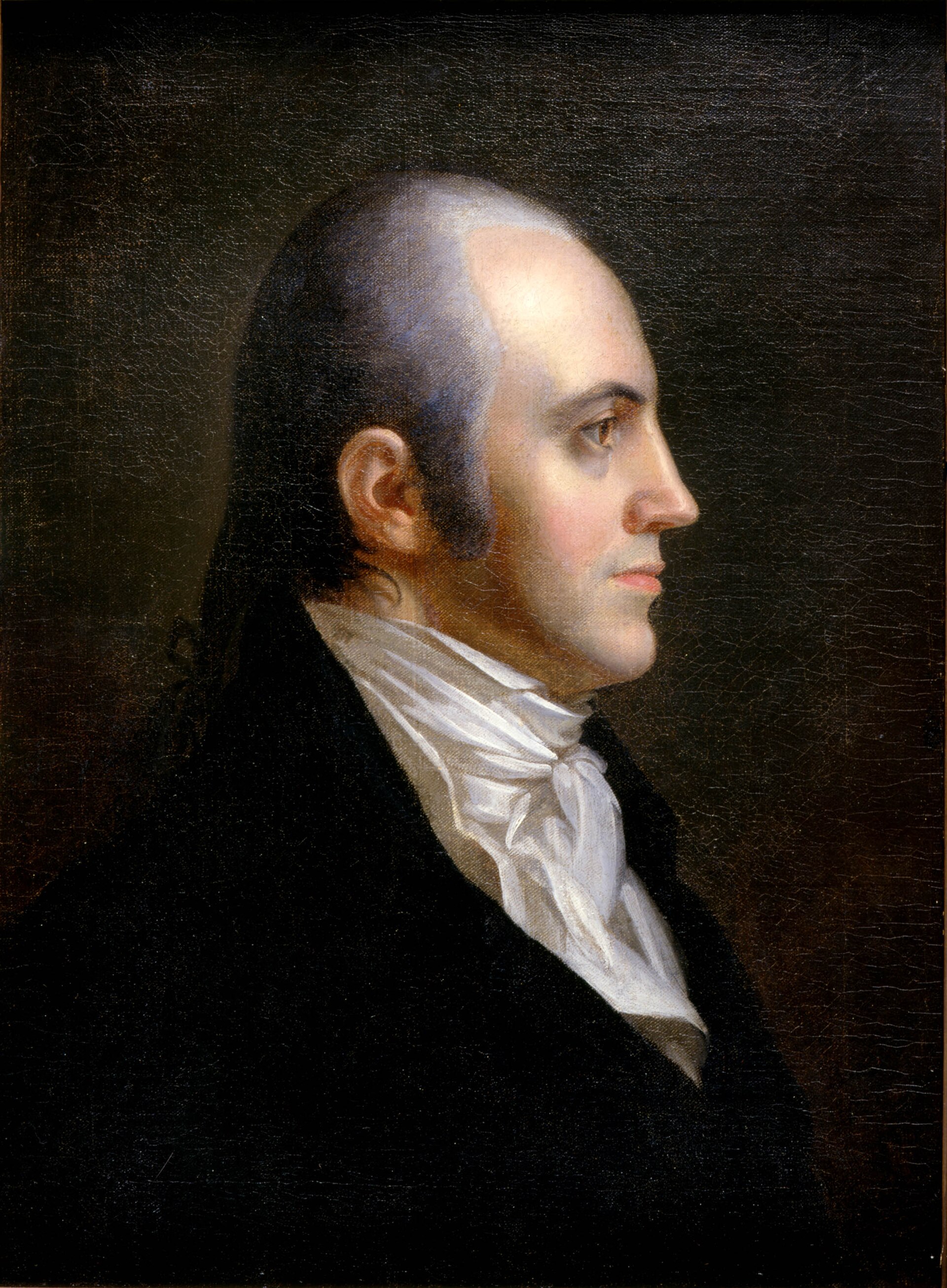
- Aaron Burr (1756–1836) title QS:P1476,en:"Aaron Burr (1756–1836) " label QS:Len,"Aaron Burr (1756–1836) " by John Vanderlyn (1802 date QS:P571,+1802-00-00T00:00:00Z/)
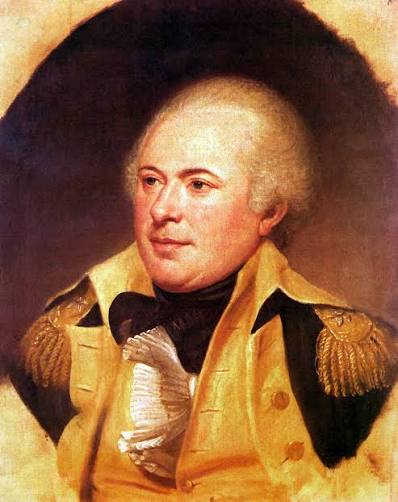
- James Wilkinson by Charles Willson Peale (1797 date QS:P571,+1797-00-00T00:00:00Z/)
- Aaron Burr 1803 Painting (cropped) by John Vanderlyn (circa 1803 date QS:P,+1803-00-00T00:00:0)
- Rembrandt Peale - Thomas Jefferson title QS:P1476,en:"Rembrandt Peale - Thomas Jefferson " label QS:Len,"Rembrandt Peale - Thomas Jefferson " label QS:Lbn,"টমাস জেফারসন" label QS:Lru,"Томас Джефферсон" label QS:Lde,"Thomas Jefferson" by Rembrandt Peale (1800)
- Alexander Hamilton (1755 -1757 - 1804) by Vitold Muratov - скан и дигитализация
- Lloyd's map of the lower Mississippi River from St
- The Spanish Borderlands (1921), map of New Spain by Internet Archive Book Images (1918)
- Geography 028 - Map of the Louisiana Purchase - 1803 by BioKnowlogy (2023-02-13 07:23:06)
- James Wilkinson by John Wesley Jarvis by John Wesley Jarvis (5 April 2012)
- Gen
- Aaron Burr post-failure by John Vanderlyn (circa 1803 date QS:P,+1803-00-00T00:00:0)
- Har
- U.S. Senate: About the Vice President | Vice Presidents of the United States
- Commanding Generals and Chiefs of Staff, 1775-2022
- Monticello | Aaron Burr
Further reading
- The Treason Trial of Aaron Burr: Law, Politics, and the Character Wars of the New Nation by R. Kent Newmyer. Explains why the constitutional standard for treason mattered more at trial than suspicions about Burr’s plans.